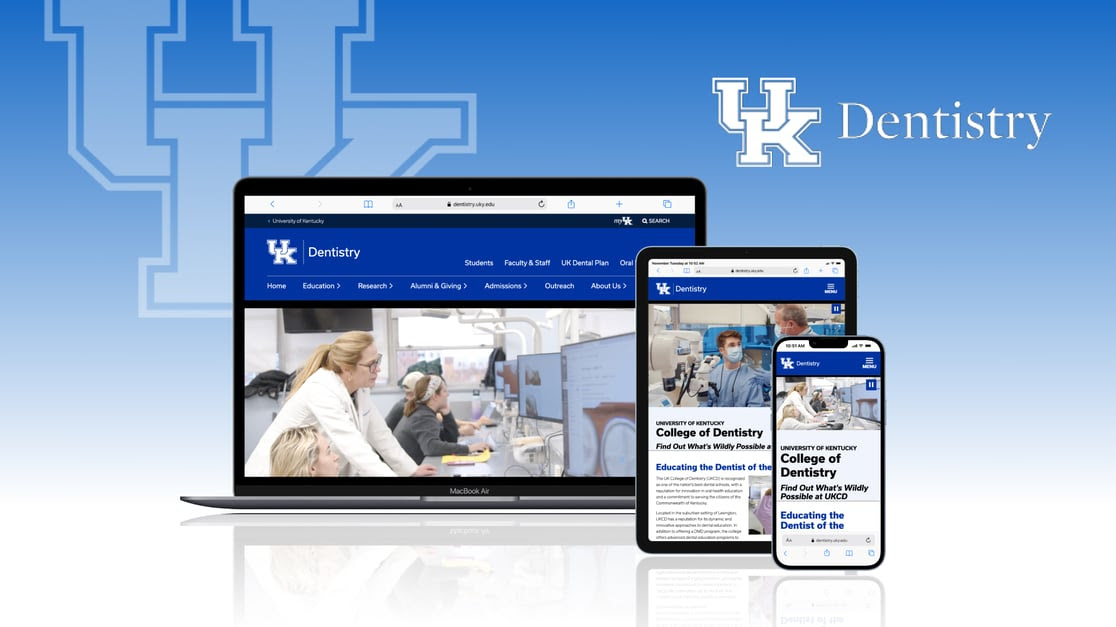
My name is Taylor Akin, and I'm a Software Engineer at APAX Software. As the product owner and lead developer for the University of Kentucky College of Dentistry's website rebuild, I had the opportunity to guide this project from discovery through launch. After working on numerous Drupal migrations over the past six years, this project stood out — not just for its technical complexity, but for the chance to modernize how an entire college communicates with students, faculty, and patients. Here's how we transformed their digital presence.
When the College of Dentistry first contacted APAX in early 2024, they were facing a critical deadline. Their website had been running on Drupal 7 since 2012, and with Drupal 7 reaching its official end-of-life in January 2025. But the urgency went beyond just the EOL date.
The site had accumulated over a decade of technical debt. Content editors were struggling with an outdated administrative interface that made simple updates unnecessarily complicated. The payment processing system for continuing education registrations and alumni events relied on deprecated modules that were becoming increasingly unreliable. Mobile responsiveness was poor — a significant problem when nearly 60% of their traffic came from smartphones and tablets. And critically, the site's information architecture had organically grown over the years into a sprawling structure that made it difficult for prospective students to find program information and for patients to locate specialty clinic services.
Beyond the technical challenges, there was a brand alignment issue. As UK had evolved its digital standards and implemented the Limestone theming system across campus websites, the College of Dentistry's site looked increasingly out of step with the broader university web presence.
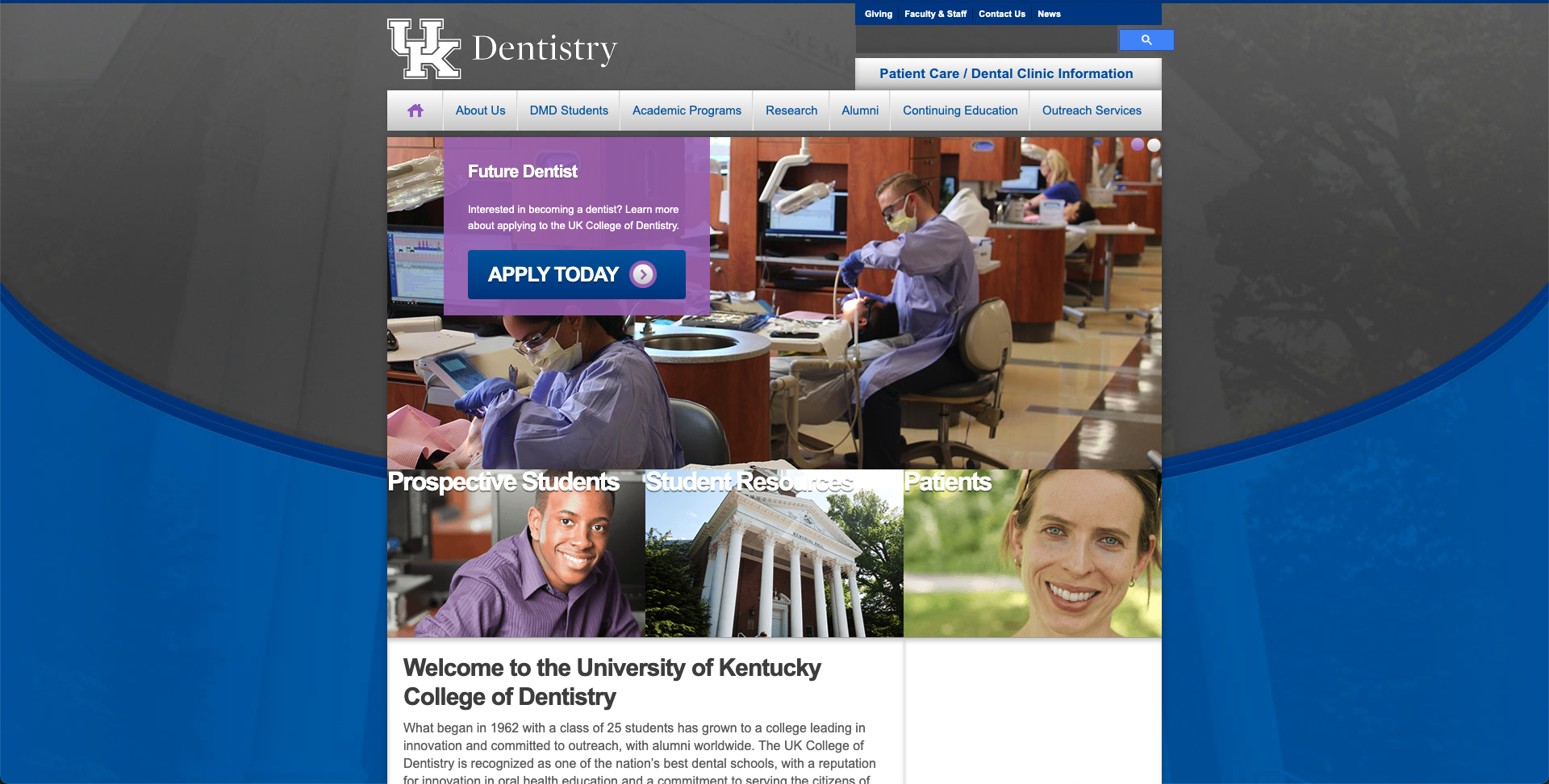
It's important to understand that moving from Drupal 7 to Drupal 10 isn't a simple software upgrade — it's a complete rebuild. Drupal 7 was released in 2011, and since then, the platform has undergone a fundamental architectural transformation.
Drupal 10 is built on a Symfony-based, object-oriented architecture that's far more flexible and scalable than Drupal 7's legacy system. Where Drupal 7 used PHP templates for theming, Drupal 10 uses the modern Twig templating engine. Where Drupal 7 required contributed modules or database shuffling to manage configuration across development, staging, and production environments, Drupal 10 has a built-in configuration management system that lets developers export site configuration to files and track them in version control.
The content editing experience is dramatically improved — Drupal 10 offers features like advanced media management and CKEditor 5 for inline editing, along with improved accessibility and layout builder enhancements that can transform content workflows.
But here's the critical issue: Drupal 7's end of life on January 5, 2025, means no more extensions to the deadline, no more security updates, and no more community support. As Drupal 7 approaches its end of life, the community's focus on security diminishes, putting Drupal 7 websites at risk, and contributed modules and themes that sites rely on to lose maintenance support.
At APAX Software, we've successfully migrated numerous websites from Drupal 7 to Drupal 10. Our team has developed specialized expertise in navigating the complexities of these migrations — from evaluating and replacing hundreds of contributed modules, to rebuilding custom functionality with modern approaches, to ensuring WCAG accessibility compliance throughout. We understand the unique challenges academic institutions face: balancing institutional brand standards with departmental needs, managing complex user authentication systems like LinkBlue/LDAP, and ensuring mission-critical features like payment processing and event registration work flawlessly from day one.
To deliver a site that balances robust functionality with editorial freedom, we chose a powerful foundation: Drupal 10 CMS integrated with the University of Kentucky's Limestone theming system. This approach gave the College of Dentistry a cohesive brand experience that aligns with UK's web standards while providing the flexibility to showcase their unique programs, faculty, and dental clinic services.
Like many academic institutions, the College of Dentistry team values the ability to manage their own content without waiting on developers. We designed a comprehensive component library with carousels, accordions, event calendars, and faculty directories — all built to be intuitive for content editors. This ensures they can quickly update information about their DMD programs, specialty residencies, continuing education opportunities, and patient care services as their needs evolve.
One particularly challenging aspect of this project was modernizing the webform payment integration system. The old site relied heavily on deprecated modules and custom payment processing with some third party services. We rebuilt this functionality from the ground up using modern Drupal 10 webform capabilities, ensuring that alumni event registrations, continuing education enrollment, and other fee-based submissions would continue to work seamlessly — but with better security, reliability, and a cleaner user experience.
We also tackled a comprehensive module audit, evaluating 90+ Drupal 7 modules for Drupal 10 compatibility and finding modern alternatives where needed. This included implementing LDAP authentication with UK's LinkBlue system, ensuring faculty, staff, and students could access protected resources with their university credentials.
Throughout this project, we worked closely with the College of Dentistry's communications and IT teams, meeting bi-weekly to review progress, gather feedback, and ensure the new site would serve their diverse audiences. Their intimate knowledge of their users' needs was invaluable in shaping the final product.
The site now provides prospective students, current students, faculty, alumni, and patients with a faster, more accessible way to find the information they need. And just as importantly, it gives content managers the tools to keep their site fresh and relevant.
It's been a pleasure working with the UK College of Dentistry team throughout this transformation. Huge thanks to the College of Dentistry team for being such collaborative partners throughout this process. And shoutout to our team at APAX Software for navigating the complexities of this legacy migration with skill and dedication.